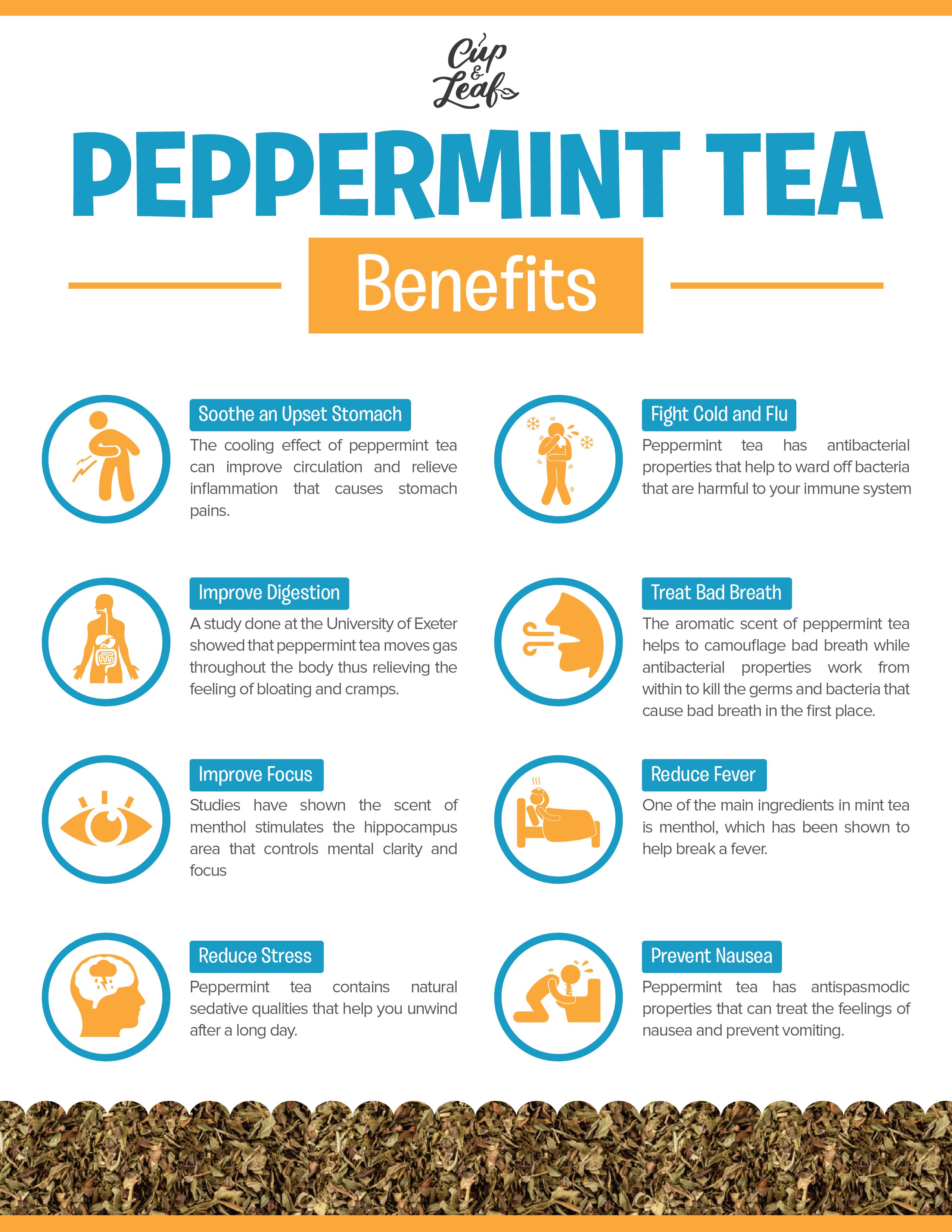
· Sip peppermint tea to enjoy benefits like refreshing hydration, digestive comfort, and stress relief, without the caffeine jitters. With a calming aroma and soothing menthol, peppermint tea promotes relaxation and can ease tension headaches. Peppermint tea is naturally sweet and free of caffeine. It may be linked to health benefits, including improving digestion, boosting focus, and relieving migraine.Peppermint (Mentha × piperita) is an aromatic herb in the mint family that is a cross between watermint and spearmint (1).Native to Europe and Asia, it has been used for thousands of years for its pleasant, minty taste and health benefits.Peppermint is used as a flavoring in breath mints, candies, and other foods. Additionally, many people consume peppermint as a refreshing, caffeine-free tea.Peppermint leaves contain several essential oils including menthol, menthone, and limonene (2).Menthol gives peppermint its cooling properties and recognizably minty scent.See full list on healthline.comPeppermint may relieve digestive symptoms, such as gas, bloating, and indigestion. Animal studies indicate that peppermint relaxes your digestive system and may ease pain. It also prevents smooth muscles from contracting, which could relieve spasms in your gut (3).A 2014 review of nine studies in 726 people with irritable bowel syndrome (IBS) treated with peppermint oil for at least 2 weeks concluded that peppermint provided significantly better symptom relief than a placebo (4). In one study in 72 people with IBS, peppermint oil capsules reduced IBS symptoms by 40% after 4 weeks, compared to only 24.3% with a placebo (5). Additionally, in a review of 14 clinical trials in nearly 2,000 children, peppermint reduced the frequency, length, and severity of abdominal pain (6). Furthermore, another study showed that the scent of peppermint oil drops reduced the incidence of nausea and vomiting and decreased the severity of nausea in people undergoing chemotherapy (7).See full list on healthline.comAs peppermint acts as a muscle relaxant and pain reliever, it may diminish certain types of headaches (8).The menthol in peppermint oil increases blood flow and provides a cooling sensation, possibly easing pain (9).In one 2010 randomized clinical study in 35 people with migraines, peppermint oil applied to the forehead and temples significantly reduced pain after 2 hours, compared to a placebo (10). Another study found that administering peppermint oil drops into the nose reduced the intensity and frequency of headaches and was as effective as lidocaine, a common pain reliever (11).While the aroma of peppermint tea may help relax muscles and improve headache pain, there is no supporting scientific evidence to confirm this effect. However, applying peppermint oil to your temples may help. summarySee full list on healthline.comThere’s a reason why peppermint is a common flavoring for toothpastes, mouthwashes, and chewing gums. In addition to its pleasant smell, peppermint has antibacterial properties that help kill germs that cause dental plaque, which may improve your breath (12).In one study, people who had undergone spine surgery and had received a rinse made with peppermint, tea tree, and lemon oils experienced improvement in bad breath symptoms compared to those who did not receive the oils (13). In another 2013 study, female students given a peppermint mouth rinse experienced an improvement in breath after 1 week, compared to the control group (14). While there is no evidence from scientific studies that drinking peppermint tea has the same effect, the compounds in peppermint have been shown to improve breath. summarySee full list on healthline.comPeppermint has antibacterial, antiviral, and anti-inflammatory properties. Because of this, peppermint tea may alleviate clogged sinuses due to infections, the common cold, and allergies (15).Additionally, some older research demonstrates that menthol — one of the active compounds in peppermint — improves the perception of airflow in your nasal cavity. Therefore, steam from peppermint tea may help you feel as though your breathing is easier (16).Furthermore, warm liquids, such as chicken broth and tea, have been shown to temporarily improve symptoms of sinus congestion such as a runny nose, cough, and sore throat in some older studies (17).Though peppermint tea has not been studied for its effects on nasal congestion, evidence suggests that it may be helpful. summaryWhile there is limited evidence that drinking peppermint tea may help unclog your sinuses, a warm beverage containing menthol — such as peppermint tea — may help you breathe a little easier.See full list on healthline.comPeppermint tea may improve energy levels and reduce fatigue. While there are no studies on peppermint tea specifically, research demonstrates that natural compounds in peppermint may have beneficial effects on energy. In one study, 24 healthy young people experienced less mental fatigue during a cognitive test when given peppermint oil capsules (18). In another study, peppermint oil aromatherapy was found to reduce the incidence of fatigue more effectively than a placebo in people admitted to a cardiology center (19).summaryPeppermint oil has been shown to relieve mental and physical fatigue in some studies, but research specifically on peppermint tea is lacking.See full list on healthline.comBecause peppermint acts as a muscle relaxant, it may relieve menstrual cramps (15).While peppermint tea has not been studied to that effect, compounds in peppermint have been shown to improve symptoms. In one study in 127 females with painful periods, peppermint extract capsules were found to be as effective as a non-steroidal anti-inflammatory drug in reducing the intensity and duration of pain (20). Though additional research is needed, it is possible that peppermint tea could have similar effects.summaryDrinking peppermint tea may reduce the intensity and length of menstrual cramps since peppermint helps prevent muscle contractions. However, more research is needed.See full list on healthline.comWhile there are no studies on the antibacterial effects of peppermint tea, peppermint oil has been shown to effectively kill bacteria (21).In one study, peppermint oil was found to kill and prevent the growth of common food-borne bacteria including E. coli, Listeria, and Salmonella in pineapple and mango juices (22). Peppermint oil also kills several types of bacteria that lead to illnesses in humans, including Staphylococcus and pneumonia-linked bacteria (23).Additionally, studies indicate that peppermint reduces several types of bacteria commonly found in your mouth (12).Furthermore, menthol has also demonstrated antibacterial activity in some older test-tube studies (24). summarySee full list on healthline.comPeppermint tea is an ideal choice before bed, as it’s naturally caffeine-free. What’s more, peppermint’s capacity as a muscle relaxant may help you relax before bedtime (15).That said, there is not much scientific evidence that peppermint enhances sleep.However, one study found that inhaling three drops of peppermint oil per day over a 7-day period improved sleep quality in people with cancer (25).Still, more high quality studies on the effects of peppermint on sleep are needed.summarySee full list on healthline.comPeppermint tea is naturally calorie-free and has a pleasantly sweet flavor, which makes it a smart choice when you’re trying to lose weight. However, there is not much research on the effects of peppermint tea on weight. In a 2013 study in 13 healthy people, taking a peppermint oil capsule resulted in reduced appetite compared to not taking peppermint (26).On the other hand, an animal study showed that mice given peppermint extracts gained more weight than the control group (27). Therefore, more research is needed on peppermint and weight loss.summarySee full list on healthline.comPeppermint tea is a caffeine-free beverage that may have various health benefits, such as improving digestion, relieving headaches, and freshening breath. Learn more about the evidence behind peppermint tea and its extracts, as well as how to use them safely.See full list on healthline.comSep 17, 2025 · Potential benefits of peppermint tea include fresher breath, headache relief, improved digestion, and relief from menstrual cramps. However, more research is necessary to support these benefits. · In this comprehensive guide, we’ll explore 12 science-backed benefits of pepperminttea and extracts, how to prepare it properly, and important considerations for incorporating this healthful beverage into your daily routine. What Makes PeppermintTea Special? 1. Supports Digestive Health and Reduces Bloating. 2. · Unlock the health benefits of peppermint tea! From soothing digestion to boosting focus, explore our complete guide on daily uses, weight loss support, and side effects. · Discover the ultimate guide to pepperminttea. Learn its nutritional facts, 20 health benefits, 10 side effects, how to brew it, best times to drink, who should or shouldn't drink it, and precautions to keep in mind. Is peppermint tea good for You?Peppermint tea benefits are wide-ranging—and you can reap them by enjoying it iced or hot. A cup or two daily is the optimal amount to sip in all the health benefits, but many people drink it in lieu of other teas, coffee, or caffeinated drinks simply because it is revitalizing and delicious.Is peppermint tea good for digestion?Peppermint leaves come from the peppermint plant (Mentha piperita), an herb in the mint (Lamiaceae) family. 1 To make peppermint tea, you can use whole peppermint leaves steeped in cold or hot water. Peppermint Tea for Digestion: What’s True? One of the best-known benefits of mint tea is it helps with digestion.Is peppermint tea good for weight loss?Peppermint tea is naturally calorie-free and has a pleasantly sweet flavor, which makes it a smart choice when you’re trying to lose weight. However, there is not much research on the effects of peppermint tea on weight.What is peppermint tea?Peppermint tea is a popular herbal tea that is naturally calorie- and caffeine-free. Some research suggests that peppermint may have certain health benefits, such as fresher breath, better digestion, and reduced headache pain. Peppermint also has antibacterial properties. · Pepperminttea is known for easing bloating, diarrhea, constipation, and other stomach and pelvic discomforts. Its antibacterial, antiviral, and anti-inflammatory properties make it a go-to for people seeking relief from illness symptoms, bad breath, and more. Peppermint tea is naturally sweet and free of caffeine. It may be linked to health benefits, including improving digestion, boosting focus, and relieving migraine.Peppermint (Mentha × piperita) is an aromatic herb in the mint family that is a cross between watermint and spearmint (1).Native to Europe and Asia, it has been used for thousands of years for its pleasant, minty taste and health benefits.Peppermint is used as a flavoring in breath mints, candies, and other foods. Additionally, many people consume peppermint as a refreshing, caffeine-free tea.Peppermint leaves contain several essential oils including menthol, menthone, and limonene (2).Menthol gives peppermint its cooling properties and recognizably minty scent.See full list on healthline.comPeppermint may relieve digestive symptoms, such as gas, bloating, and indigestion. Animal studies indicate that peppermint relaxes your digestive system and may ease pain. It also prevents smooth muscles from contracting, which could relieve spasms in your gut (3).A 2014 review of nine studies in 726 people with irritable bowel syndrome (IBS) treated with peppermint oil for at least 2 weeks concluded that peppermint provided significantly better symptom relief than a placebo (4). In one study in 72 people with IBS, peppermint oil capsules reduced IBS symptoms by 40% after 4 weeks, compared to only 24.3% with a placebo (5). Additionally, in a review of 14 clinical trials in nearly 2,000 children, peppermint reduced the frequency, length, and severity of abdominal pain (6). Furthermore, another study showed that the scent of peppermint oil drops reduced the incidence of nausea and vomiting and decreased the severity of nausea in people undergoing chemotherapy (7).See full list on healthline.comAs peppermint acts as a muscle relaxant and pain reliever, it may diminish certain types of headaches (8).The menthol in peppermint oil increases blood flow and provides a cooling sensation, possibly easing pain (9).In one 2010 randomized clinical study in 35 people with migraines, peppermint oil applied to the forehead and temples significantly reduced pain after 2 hours, compared to a placebo (10). Another study found that administering peppermint oil drops into the nose reduced the intensity and frequency of headaches and was as effective as lidocaine, a common pain reliever (11).While the aroma of peppermint tea may help relax muscles and improve headache pain, there is no supporting scientific evidence to confirm this effect. However, applying peppermint oil to your temples may help. summarySee full list on healthline.comThere’s a reason why peppermint is a common flavoring for toothpastes, mouthwashes, and chewing gums. In addition to its pleasant smell, peppermint has antibacterial properties that help kill germs that cause dental plaque, which may improve your breath (12).In one study, people who had undergone spine surgery and had received a rinse made with peppermint, tea tree, and lemon oils experienced improvement in bad breath symptoms compared to those who did not receive the oils (13). In another 2013 study, female students given a peppermint mouth rinse experienced an improvement in breath after 1 week, compared to the control group (14). While there is no evidence from scientific studies that drinking peppermint tea has the same effect, the compounds in peppermint have been shown to improve breath. summarySee full list on healthline.comPeppermint has antibacterial, antiviral, and anti-inflammatory properties. Because of this, peppermint tea may alleviate clogged sinuses due to infections, the common cold, and allergies (15).Additionally, some older research demonstrates that menthol — one of the active compounds in peppermint — improves the perception of airflow in your nasal cavity. Therefore, steam from peppermint tea may help you feel as though your breathing is easier (16).Furthermore, warm liquids, such as chicken broth and tea, have been shown to temporarily improve symptoms of sinus congestion such as a runny nose, cough, and sore throat in some older studies (17).Though peppermint tea has not been studied for its effects on nasal congestion, evidence suggests that it may be helpful. summaryWhile there is limited evidence that drinking peppermint tea may help unclog your sinuses, a warm beverage containing menthol — such as peppermint tea — may help you breathe a little easier.See full list on healthline.comPeppermint tea may improve energy levels and reduce fatigue. While there are no studies on peppermint tea specifically, research demonstrates that natural compounds in peppermint may have beneficial effects on energy. In one study, 24 healthy young people experienced less mental fatigue during a cognitive test when given peppermint oil capsules (18). In another study, peppermint oil aromatherapy was found to reduce the incidence of fatigue more effectively than a placebo in people admitted to a cardiology center (19).summaryPeppermint oil has been shown to relieve mental and physical fatigue in some studies, but research specifically on peppermint tea is lacking.See full list on healthline.comBecause peppermint acts as a muscle relaxant, it may relieve menstrual cramps (15).While peppermint tea has not been studied to that effect, compounds in peppermint have been shown to improve symptoms. In one study in 127 females with painful periods, peppermint extract capsules were found to be as effective as a non-steroidal anti-inflammatory drug in reducing the intensity and duration of pain (20). Though additional research is needed, it is possible that peppermint tea could have similar effects.summaryDrinking peppermint tea may reduce the intensity and length of menstrual cramps since peppermint helps prevent muscle contractions. However, more research is needed.See full list on healthline.comWhile there are no studies on the antibacterial effects of peppermint tea, peppermint oil has been shown to effectively kill bacteria (21).In one study, peppermint oil was found to kill and prevent the growth of common food-borne bacteria including E. coli, Listeria, and Salmonella in pineapple and mango juices (22). Peppermint oil also kills several types of bacteria that lead to illnesses in humans, including Staphylococcus and pneumonia-linked bacteria (23).Additionally, studies indicate that peppermint reduces several types of bacteria commonly found in your mouth (12).Furthermore, menthol has also demonstrated antibacterial activity in some older test-tube studies (24). summarySee full list on healthline.comPeppermint tea is an ideal choice before bed, as it’s naturally caffeine-free. What’s more, peppermint’s capacity as a muscle relaxant may help you relax before bedtime (15).That said, there is not much scientific evidence that peppermint enhances sleep.However, one study found that inhaling three drops of peppermint oil per day over a 7-day period improved sleep quality in people with cancer (25).Still, more high quality studies on the effects of peppermint on sleep are needed.summarySee full list on healthline.comPeppermint tea is naturally calorie-free and has a pleasantly sweet flavor, which makes it a smart choice when you’re trying to lose weight. However, there is not much research on the effects of peppermint tea on weight. In a 2013 study in 13 healthy people, taking a peppermint oil capsule resulted in reduced appetite compared to not taking peppermint (26).On the other hand, an animal study showed that mice given peppermint extracts gained more weight than the control group (27). Therefore, more research is needed on peppermint and weight loss.summarySee full list on healthline.comPeppermint tea is a caffeine-free beverage that may have various health benefits, such as improving digestion, relieving headaches, and freshening breath. Learn more about the evidence behind peppermint tea and its extracts, as well as how to use them safely.See full list on healthline.comSep 17, 2025 · Potential benefits of peppermint tea include fresher breath, headache relief, improved digestion, and relief from menstrual cramps. However, more research is necessary to support these benefits. · In this comprehensive guide, we’ll explore 12 science-backed benefits of pepperminttea and extracts, how to prepare it properly, and important considerations for incorporating this healthful beverage into your daily routine. What Makes PeppermintTea Special? 1. Supports Digestive Health and Reduces Bloating. 2. · Unlock the health benefits of peppermint tea! From soothing digestion to boosting focus, explore our complete guide on daily uses, weight loss support, and side effects. · Discover the ultimate guide to pepperminttea. Learn its nutritional facts, 20 health benefits, 10 side effects, how to brew it, best times to drink, who should or shouldn't drink it, and precautions to keep in mind. Is peppermint tea good for You?Peppermint tea benefits are wide-ranging—and you can reap them by enjoying it iced or hot. A cup or two daily is the optimal amount to sip in all the health benefits, but many people drink it in lieu of other teas, coffee, or caffeinated drinks simply because it is revitalizing and delicious.Is peppermint tea good for digestion?Peppermint leaves come from the peppermint plant (Mentha piperita), an herb in the mint (Lamiaceae) family. 1 To make peppermint tea, you can use whole peppermint leaves steeped in cold or hot water. Peppermint Tea for Digestion: What’s True? One of the best-known benefits of mint tea is it helps with digestion.Is peppermint tea good for weight loss?Peppermint tea is naturally calorie-free and has a pleasantly sweet flavor, which makes it a smart choice when you’re trying to lose weight. However, there is not much research on the effects of peppermint tea on weight.What is peppermint tea?Peppermint tea is a popular herbal tea that is naturally calorie- and caffeine-free. Some research suggests that peppermint may have certain health benefits, such as fresher breath, better digestion, and reduced headache pain. Peppermint also has antibacterial properties. · Pepperminttea is known for easing bloating, diarrhea, constipation, and other stomach and pelvic discomforts. Its antibacterial, antiviral, and anti-inflammatory properties make it a go-to for people seeking relief from illness symptoms, bad breath, and more. · Potential benefits of peppermint tea include fresher breath, headache relief, improved digestion, and relief from menstrual cramps. However, more research is necessary to support these benefits. · In this comprehensive guide, we’ll explore 12 science-backed benefits of pepperminttea and extracts, how to prepare it properly, and important considerations for incorporating this healthful beverage into your daily routine. What Makes PeppermintTea Special? 1. Supports Digestive Health and Reduces Bloating. 2. · Unlock the health benefits of peppermint tea! From soothing digestion to boosting focus, explore our complete guide on daily uses, weight loss support, and side effects. · Discover the ultimate guide to pepperminttea. Learn its nutritional facts, 20 health benefits, 10 side effects, how to brew it, best times to drink, who should or shouldn't drink it, and precautions to keep in mind. · Pepperminttea is known for easing bloating, diarrhea, constipation, and other stomach and pelvic discomforts. Its antibacterial, antiviral, and anti-inflammatory properties make it a go-to for people seeking relief from illness symptoms, bad breath, and more.