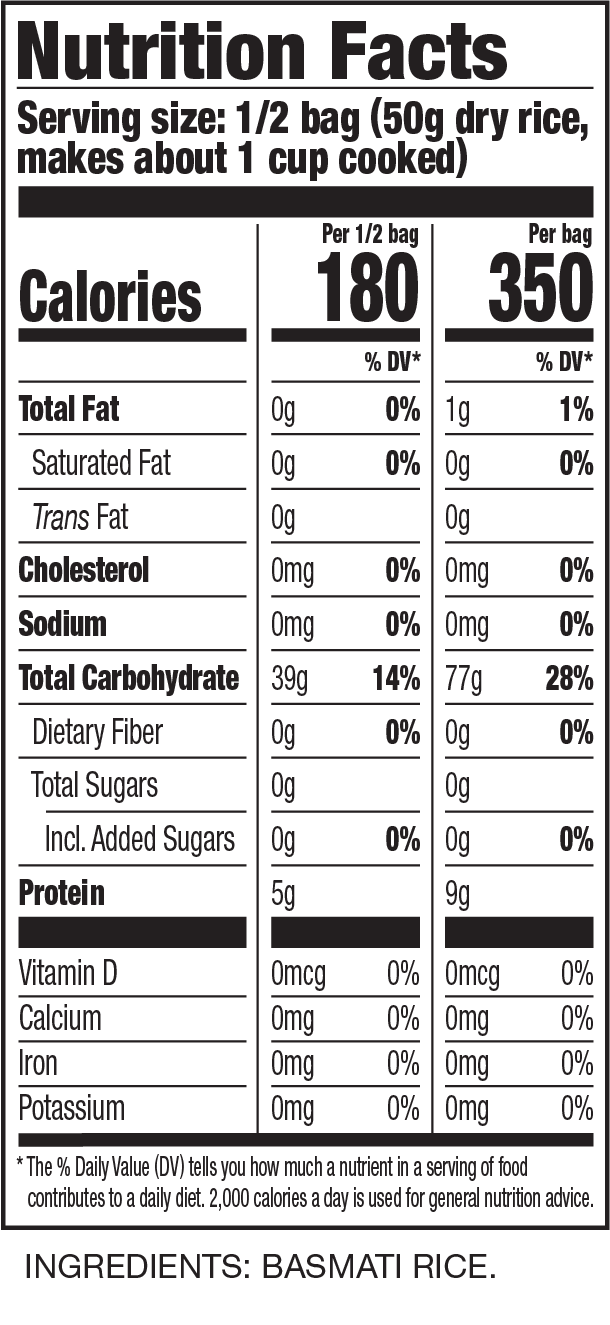
Basmatirice is a popular long grained rice traditionally from the Indian subcontinent. They’re extremely aromatic with a light nutty flavor. What we look for in Perfect BasmatiRice? In terms of weight management, the fiber content in "brown basmatiricenutrition" can aid in feeling fuller for longer periods, thus helping in portion control. Additionally, for plant-based diets... BasmatiRiceNutrition Facts - Swolverine. Some basmatirice may be enriched, meaning that certain nutrients are added during the manufacturing process to boost the nutritional... Basmatirice is light, fluffy and considered a kitchen staple in Ayurvedic cooking (and kitchens around the world!)5 lb: basmatiricenutrition label. Open media 2 in modal. Serving around 3/4 glass basmatirice contains 150 calories. The greater parts of the calories originate from starches basmatirice, a small amount of fat and protein. Basmatiricenutrition, Healthy food facts, Healthy foods to make. BasmatiRice Health Benefits Infographic.BasmatiRiceNutritional Facts. Indian Rice Milling Market. BasmatiRice. Nutrition Facts. Serving Size.There are 202 calories in 1 serving (125 g) of Uncle Ben's BasmatiRice. Calorie Breakdown: 15% fat, 75% carbs, 10% prot. BasmatiRice. Nutrition Facts. Serving Size.- * The % Daily Value (DV) tells you how much a nutrient in a serving of food contributes to a daily diet. Nutrition Facts. For 1 Serving of side of basmatirice. Nutrient. Value. ...As per Journal Critical Reviews in Food Science and Nutrition).(e-ISSN: 2582-8223). has a very nutritive profile. Basmatirice has lower arsenic content than other varieties of rice. Unlike Basmatirice and Non-Basmatirice does not refer to all varieties of rice that do not fall under the Basmati category.Basmati vs Non-BasmatiRiceNutrition Comparison. Nutrition information for White RiceBasmati. Track calories, carbs, fat, and 18 other key nutrients. BasmatiricenutritionBasmatirice versus jasmine riceHow to choose the best basmatirice · Find out the nutrients in basmatirice, the health benefits of basmatirice, how to prepare it, and more. One cup of basmati rice contains just over 200 calories. It’s often better to eat than white rice, which is a refined grain.Basmati rice is a type of rice common in Indian and South Asian cuisine.Available in both white and brown varieties, it’s known for its nutty flavor and pleasant aroma.Still, you may want to know whether this long-grain rice is healthy and how it compares with other kinds of rice.See full list on healthline.comAlthough the exact nutrients vary based on the specific type of basmati, each serving is generally high in carbs and calories, as well as micronutrients like folate, thiamine, and selenium.One cup (163 grams) of cooked white basmati rice contains (1):•Calories: 210•Protein: 4.4 grams•Fat: 0.5 grams•Carbs: 45.6 gramsSee full list on healthline.comLow in arsenicCompared with other types of rice, basmati is generally lower in arsenic, a heavy metal that can harm your health and potentially increase your risk of diabetes, heart problems, and certain cancers (3). Arsenic tends to accumulate more in rice than in other grains, which can be particularly concerning for those who eat rice on a regular basis (4). However, some studies have found that basmati rice from California, India, or Pakistan contains some of the lowest levels of arsenic, compared with other rice varieties (5). Furthermore, it should be noted that brown rice varieties tend to be higher in arsenic than white rice, as arsenic accumulates in the hard outer bran layer.May be enrichedWhite basmati rice is often enriched, meaning that certain nutrients are added during processing to help boost the nutritional value. This can make it easier to meet your needs for a variety of important vitamins and minerals. In particular, rice and other grains are often enriched with iron and B vitamins like folic acid, thiamine, and niacin (6).Some types are whole grainsBrown basmati rice is considered a whole grain, meaning that it contains all three parts of the kernel — the germ, bran, and endosperm. Whole grains are associated with multiple health benefits. For instance, an analysis of 45 studies tied whole grain intake to a lower risk of heart disease, cancer, and premature death (7). Another review associated regular intake of whole grains, including brown rice, with a lower risk of type 2 diabetes (8). What’s more, an 8-week study in 80 people found that replacing refined grains with whole grains lowered levels of inflammatory markers (9). summary Basmati is lower in arsenic than other types of rice and often enriched with important vitamins and minerals. Brown basmati is also considered a whole grain.See full list on healthline.comUnlike brown basmati, white basmati is a refined grain, meaning that it has been stripped of many valuable nutrients during processing. Some studies suggest that eating more refined grains can negatively affect blood sugar control and may be associated with a higher risk of type 2 diabetes (10, 11).What’s more, a study in over 10,000 people linked dietary patterns that included white rice to a higher risk of obesity (12).Additionally, a study in 26,006 people associated white rice intake with a higher risk of metabolic syndrome, which is a group of conditions that can increase your risk of heart disease, stroke, and type 2 diabetes (13).These effects may be due to white rice’s high number of carbs and low amount of fiber compared with brown rice.Therefore, while white basmati rice can be enjoyed in moderation, brown basmati may be a better overall option for your health.See full list on healthline.comBasmati rice is comparable to other types of brown or white rice in terms of nutrients.Although very minute variations may exist in the calorie, carb, protein, and fiber counts between specific types of rice, it’s not enough to make much of a difference.That said, basmati typically harbors less arsenic, which may make it a good choice if rice is a staple in your diet (5).As a long-grain rice, it’s also longer and slimmer than short-grain varieties.Its nutty, floral aroma and soft, fluffy texture work well in many Asian and Indian dishes. It’s a particularly great choice for rice puddings, pilafs, and side dishes.summarySee full list on healthline.comBasmati is an aromatic, long-grain rice that’s lower in arsenic than other types of rice. It’s sometimes enriched with important vitamins and minerals.It’s available in both white and brown varieties. Whenever possible, you should select brown basmati, as refined grains like white rice are associated with several negative health effects.Shop for brown basmati rice online.See full list on healthline.com Find out the calories, proteins, fats, carbohydrates, vitamins and minerals of rice, basmati, raw per 100 grams. Compare the nutritional value of rice, basmati, raw with other grains and see how much sugar and fat it contains. · Learn how basmati rice compares to other rice varieties in terms of fiber, vitamins, minerals, and arsenic. Find out the pros and cons of white and brown basmati rice, and get some recipes to try. · Discover if basmatirice is healthy in this full nutritional guide, which also includes benefits, comparisons, and tips on how to cook basmatirice for everyday meals. · This comprehensive exploration examines the science behind basmatiricenutrition, revealing why nutritionists and health-conscious consumers increasingly recommend this grain as part of a balanced diet. Is brown basmati rice healthy?In comparison, brown basmati rice is slightly higher in calories, carbs, and fiber. It also provides more magnesium, vitamin E, zinc, potassium, and phosphorus (2). summary Basmati rice is typically high in carbs and micronutrients like thiamine, folate, and selenium. Basmati rice may be associated with several health benefits.How many calories are in a cup of basmati rice?One cup of basmati rice contains just over 200 calories. It’s often better to eat than white rice, which is a refined grain. Basmati rice is a type of rice common in Indian and South Asian cuisine. Available in both white and brown varieties, it’s known for its nutty flavor and pleasant aroma.What are the health benefits of basmati rice?Basmati rice may be associated with several health benefits. Compared with other types of rice, basmati is generally lower in arsenic, a heavy metal that can harm your health and potentially increase your risk of diabetes, heart problems, and certain cancers (3).How many grams is a portion of rice Basmati raw?A portion of rice, basmati, raw corresponds to 75 grams. -1 g. +1 g. See how much sugar and fat rice, basmati, raw contains per 100 grams compared to the RDI for an adult. What do I have to do to burn 1 serving (75 grams) rice, basmati, raw ? · Discover the detailed basmati rice nutrition facts, including calories, carbs, and protein. Learn why this aromatic rice is a healthy choice! Find out the calories, proteins, fats, carbohydrates, vitamins and minerals of rice, basmati, raw per 100 grams. Compare the nutritional value of rice, basmati, raw with other grains and see how much sugar and fat it contains. · Learn how basmati rice compares to other rice varieties in terms of fiber, vitamins, minerals, and arsenic. Find out the pros and cons of white and brown basmati rice, and get some recipes to try. · Discover if basmatirice is healthy in this full nutritional guide, which also includes benefits, comparisons, and tips on how to cook basmatirice for everyday meals. · This comprehensive exploration examines the science behind basmatiricenutrition, revealing why nutritionists and health-conscious consumers increasingly recommend this grain as part of a balanced diet. · Discover the detailed basmati rice nutrition facts, including calories, carbs, and protein. Learn why this aromatic rice is a healthy choice!